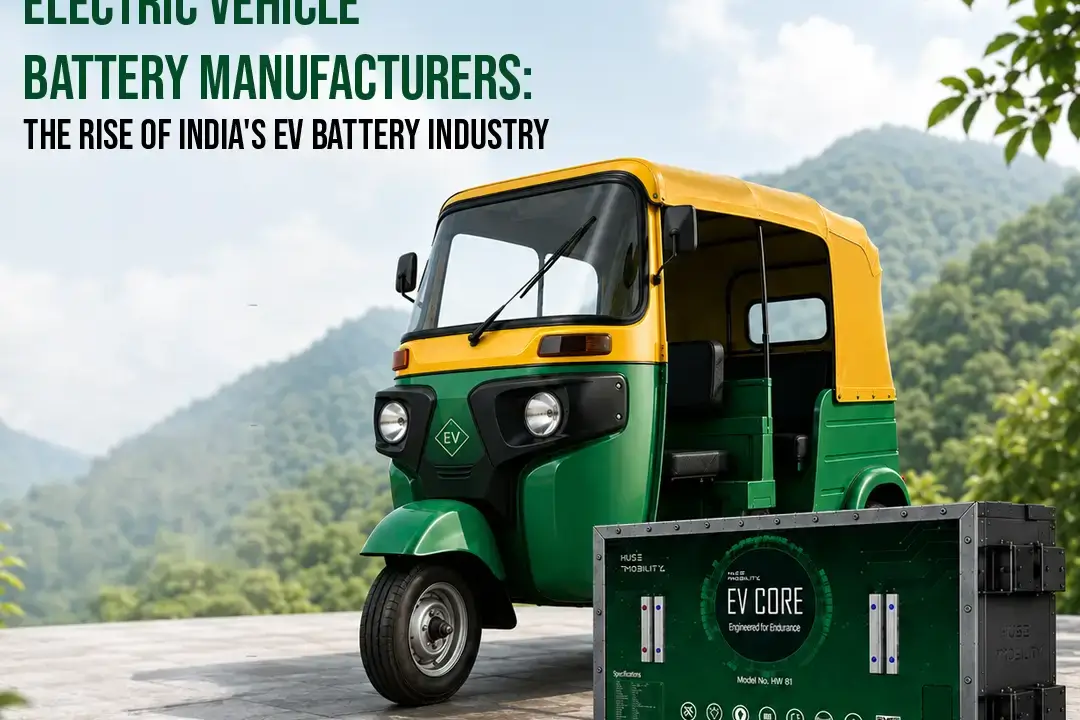

EV Battery Manufacturer in India : Powering the Electric Vehicle Revolution
The mobility landscape in India is evolving at a rapid pace with the growing adoption of electric vehicles. As a result, EV battery manufacturer in India are gaining significant traction for their role in enabling clean transportation and reducing pollution. Local battery manufacturing not only lowers costs but also strengthens domestic supply chains. This momentum is further driven by government support, rising fuel prices, and increased consumer awareness, positioning India as an attractive hub for investors, automotive players, and technology partners.
India’s battery industry has matured past early stage development. A few years ago, the industry consisted of a handful of battery assemblers dependent on imports. Now, there are large, varied facilities including cell manufacturers on the same scale as gigafactories, battery pack manufacturers, and established players in the energy storage industry transitioning to lithium-ion batteries.
With the increasing development in the EV industry, the need for understanding the various players has become imperative for fleet operators and original equipment manufacturers (OEMs). Many “top manufacturer” lists found on the internet are alphabetical lists of very little to no help in describing a manufacturer’s capability and specialization.
This guide presents battery manufacturers based on the business activity (i.e. manufacturing cells, battery packs, or newly entering the market as a storage manufacturer). By doing so, the objectives and offerings of each manufacturer will be better understood.
Huse Mobility provides charging infrastructure for electric vehicles. Therefore, understanding batteries and the electrical storage industry is essential. These two industries are complementary, and progress in one is dependent on progress in the other.
Choosing The Right EV Battery Manufacturer
Certain factors will be more important than a supplier’s brand recognition when you, as a potential customer, start evaluating suppliers. This will be especially true if you are an OEM, fleet operator or business customer.
Understand Battery Chemistries-
Lithium Iron Phosphate (LFP) batteries have been used in electric two wheelers and electric rickshaws and other similar applications where energy density is not crucial and other factors such as safety and cycle life are of key consideration. Passenger EVs should use a battery chemistry which gives the greatest range and LFP would not be the optimal choice for such an application.
See if a Manufacturer Aligns with Your Business
Mismatches in battery chemistry and application will significantly impact the performance of the end product. It is important that you evaluate battery manufacturers who are aligned to your business.
Consider Other Factors
Look for battery manufacturers who have safety and performance aligned Battery Management Systems (BMS) and thermal management systems. Also, consider if a manufacturer has local supply and a flexible and stable supply chain.
The Future of Battery Manufacturing in India
Battery manufacturing in India is still developing, with most businesses working in pack assembly. A couple of businesses have established large-scale battery cell manufacturing facilities, also known as gigafactories. In the coming years, with the help of government initiatives and local policies, it is likely that the battery manufacturing ecosystem will transform and develop at different levels, including raw material (cathode) and cell production.
Where Battery Technology Meets Charging Infrastructure
EV adoption is strongly correlated with advances in both battery technology and charging infrastructure. Indian battery manufacturers have an opportunity to improve battery technology to increase the pace of EV adoption in India, and charging infrastructure can also evolve to better integrate with battery systems.
This is the focus of our work at Huse Mobility. We are developing next-gen wireless charging systems to improve charging convenience for battery systems integrated into vehicles.
Understanding India’s Policies on Electric Vehicle Battery Manufacturing
India’s production of EV batteries has seen significant growth in recent years. One of the main reasons for this is the government’s plan to incentivize the manufacturing of EV batteries in the country. For an EV battery manufacturer to understand the country’s policies and the incentives given by the central and state governments, is essential to plan production in the country.
The policies outlined in this article are some of the more recent policies that are aimed at encouraging battery manufacturing. This article provides information regarding the coverage, eligible entities, and central and state government policies.
How EV Battery Manufacturers in India Are Reshaping the E-Vehicle Revolution?
The electric vehicle revolution in India is increasing at a rapid pace, and EV battery suppliers are playing a vital role in ensuring that the transition is successful. Their emphasis on domestic production, innovation, and scalability is contributing to the creation of a powerful and independent EV ecosystem.
➤ Localized Battery Making
The EV battery manufacturers in India are shifting towards domestic production to minimize reliance on imports. Localization enhances the stability of the supply chain, reduces costs, and contributes to the government programs. It empowers electric mobility and clean energy infrastructure in India.
➤ Improvements in the Chemistry of Batteries
Manufacturers are working on improvements in batteries. Such developments contribute to an increase in safety, thermal stability, and performance. The EV batteries made under these developments can be better adapted to the Indian climate and roads.
➤ Focus on Cost Optimization
One of the priorities that EV battery manufacturing has in India is cost reduction. To ensure the electric vehicles also become affordable to the mass market, companies are developing effective designs of cells, sourcing materials locally, and scalable production models.
➤ EV and Energy Storage System Integration
Indian battery manufacturers are matching battery development to vehicle platform and energy storage requirements. This integration enhances compatibility, charging efficiency, and lifecycle management. It basically serves the electric mobility and renewable energy storage purposes.
➤ Emphasis on Sustainability and Recycling
The EV battery manufacturing in India is going to focus on sustainability. Some of the efforts are battery recycling, second-life usage, and sourcing responsibly. These measures will make the EV ecosystem waste and resource-saving, as well as guarantee long-term environmental and economic sustainability.
➤ Wireless Charging Technologies
Wireless charging is emerging as a key solution that EV battery manufacturers in India and ecosystem players are exploring to improve convenience and overall user experience. By reducing dependence on physical connectors, this technology enables greater charging autonomy. Its potential applications span public infrastructure, fleet operations, and smart city ecosystems, supporting the next phase of scalable electric mobility.
Why the Focus on Local Production of EV Batteries
There has been a significant push from the Indian government to increase the production of EVs in the country. One challenge that prevented broader adoption of EVs in India was the high cost of the vehicles. This was due in part to the cost of importing the batteries. By incentivizing the local production of EV batteries, the Indian government expects to not only bring down the cost of production of EVs, but also create a local EV battery manufacturing industry.
Indian Government’s Incentive for Core Cell Manufacturing
The Indian government announced its first-ever Battery Manufacturing Policy in 2020. As part of the policy, the government launched the Advanced Chemistry Cell (ACC) Production-Linked Incentive Scheme. The scheme offers incentives to manufacturer companies for large-scale manufacturing of advanced chemistry cells, such as lithium-ion cells. The incentives, however, are payable only upon achievement of the specified manufacturing targets.
The scheme is open to all types of manufacturers. It encourages large-scale production of lithium-ion batteries. There are many incentive schemes across the world which reward manufacturers for local value addition. In this scheme, manufacturing companies are rewarded based on the percentage of the battery value chain that they manufacture in India.
The Government of India has allotted capacities to a limited number of companies under the scheme. The allotted companies include Ola Electric and Reliance New Energy. Other large companies of the country also find a place in the allotted companies list. Amara Raja and Exide, which are in the manufacturing of lead acid batteries for over three decades, did not find a place in the allotted companies under the first and second tranche of the scheme.
Accelerating local manufacturing of lithium-ion cells in the country will enable battery pack manufacturers to source cells from local suppliers, instead of depending on cell manufacturers outside the country. In this sense, the local manufacturers who come under the purview of the ACC PLI scheme will also benefit companies that do not avail the incentives.
EV Battery Manufacturers in India and Industry Competition
Competition plays a critical role in elevating quality, optimizing costs, and accelerating innovation across the EV ecosystem. Companies compete on performance, safety standards, and extended warranty offerings, while also partnering with automakers to deliver customized battery solutions. This competitive momentum ensures customers gain access to higher performance at more affordable prices, ultimately strengthening the overall electric vehicle ecosystem.
➤ Role of Private EV Battery Manufacturers in India
The startups and private companies introduce new ideas and flexibility in EV battery manufacturing in India. Firms are experimenting with new designs and inventing quick charging. Additional capital can enable a startup to increase production and reach out to more customers.
➤ Contribution of Huse Mobility
At HUSE Mobility, we innovate electric mobility through advanced battery solutions and forward looking concepts. We prioritize safety, performance, and long term reliability, developing products tailored to Indian driving and usage conditions. By delivering consistent quality, HUSE Mobility enables wider adoption of electric vehicles and builds lasting confidence in electric mobility solutions across India.
Regulatory Standards Battery Manufacturers Must Meet
Separate from incentive schemes, the federal government of India has established mandatory regulations to which battery manufacturers must adhere. Only once these are satisfied will the government allow the manufacturer to sell batteries in the country. These include, but are not limited to, the following:
BIS Certification: Established safety and quality requirements to register lithium ion batteries and cells.
AIS-156: Applicable only to the automotive industry, this standard requires testing of batteries to evaluate safety against mechanical shock and thermal propagation.
Battery Waste Management Rules: Extended producer responsibility to devise mechanisms to safely and reliably recover and dispose of spent batteries.
These regulations provide not only a pathway to Legally manufacture batteries, but more importantly establishes a process to demonstrate the manufacturer’s will to integrate safety in design of their products.
How the Incentive Layers Stack Together
From the perspective of the battery manufacturer, there are three main layers of incentives. Viability under each of the layers requires a specific batteries and cells manufacturing structure. If a manufacturer meet all the three layers, the cost of manufacture and sell batteries in the country will be lower than the competitor reliant on import. The differentiated cost position is increasingly reflected in who wins contracts to supply batteries to OEMs. The layers are as follows:
Central Production Incentive (ACC PLI): This incentive is only for local manufacturing of batteries and cells.
Central Demand Incentive (PM E-Drive): This is only for the EV sector and increase local demand for batteries.
State incentives: Reduce the overall cost to manufacture and do business in India.
How This Impacts Your Choice of Battery Supplier
Policies effectuating the localization of supply chains present opportunities to assess battery manufacturing partners. These opportunities are currently underutilized.
Manufacturers with localization policies backed by PLI are focused on building long-term, stable supply chain structures and investing in cell technology.
Pack assemblers backed by state incentives may also be producing competitively priced cells.
Partnering with manufacturers who meet the requirements of BIS and/or AIS-156 helps assess the safety of the battery system and answers the bar for consideration in serious EV applications.
Conclusion
Policy is certainly creating battery manufacturing ecosystems. In the coming years, the main limitation for the EV manufacturing ecosystem in India will no longer be the production of batteries; rather it will be the adequate and smart charging of batteries at scale. This is where the next major advancements in the EV manufacturing ecosystem will be in the areas of charging infrastructure, such as wireless charging.
To conclude, the future of clean mobility is being determined by EV battery manufacturers in India. Planned growth, talented employees and good technology help in the gradual expansion. Environmental and economic protection are also achieved through sustainable practices. Now, India is on the way to cleaner and more efficient transportation with the help of such reliable mobility solution providers as Huse Mobility. So, get yours today and take a step towards a clean environment.
FAQs about EV Battery Manufacturer in India
➤ What makes ev battery manufacturer in India important for the automotive industry?
EV battery manufacturers in India plays a crucial role in accelerating the country’s transition to electric mobility. With rising demand for electric vehicles, domestic battery production reduces dependency on imports, lowers costs, and strengthens the supply chain. Huse Mobility contributes to this growth by delivering advanced, high-performance battery solutions tailored to Indian road and climate conditions.
➤ How does Huse Mobility support electric vehicle battery manufacturers in india
Huse Mobility supports EV battery manufacturer in India by leveraging cutting-edge technology, quality control systems, and sustainable production practices. The company focuses on producing reliable, energy-efficient, and long-lasting lithium-ion battery packs that meet global safety and performance standards while catering to the growing Indian EV market.
➤ Why is local ev battery manufacturer in India beneficial for EV buyers?
Local EV battery manufacturer in India ensures better affordability, faster availability, and improved after-sales support. Companies like Huse Mobility design batteries specifically for Indian usage patterns, ensuring durability, thermal stability, and optimized performance even in extreme weather conditions.
➤ What technologies are used in ev battery manufacturer in India
EV battery manufacturers in India involves advanced technologies such as lithium-ion cell integration, battery management systems (BMS), thermal management solutions, and modular pack design. Huse Mobility integrates smart BMS technology to enhance battery life, safety, and charging efficiency, making EVs more reliable and cost-effective.
➤ How does ev battery manufacturer in India contribute to sustainability?
EV battery manufacturers in India supports the country’s sustainability goals by reducing carbon emissions and promoting clean transportation. Huse Mobility emphasizes eco-friendly production processes, efficient energy utilization, and responsible battery lifecycle management, helping build a greener and more sustainable future.
➤ What is the ACC PLI scheme for EV battery manufacturing in India?
The ACC PLI Scheme is the central government’s initiative for manufacturing lithium-ion cells and batteries in India. Under this scheme, incentives are provided to units based on the quantity of lithium-ion cells and batteries manufactured in India and the value addition by them.
➤ Are state governments also providing support to EV battery manufacture in India?
Gujarat, Tamil Nadu, Karnataka, Maharashtra, and Telangana state governments, in addition to the central government’s support through the ACC PLI scheme, have formulated schemes for providing capital subsidies, exemption from electricity duties, land, and other concessions to battery manufacturing units.
➤ What are the important certifications for EV battery manufacturing in India?
Lithium-ion cells and batteries must mandatory conform to the requirements of the Bureau of Indian Standards (BIS) and EV batteries must also conform to AIS-156 to be marketed in India.
The manufacturer of lithium-ion cells builds the cells from raw materials, which is a long and expensive process. A battery pack manufacturer, on the other hand, assembles battery packs from cells. Most EV battery companies in India outsource the production of the battery pack to companies in other countries.
➤ Are Indian EV batteries as good as batteries made outside of India?
Battery packs assembled in India can have batteries made outside of India, and if the cells meet the requirements of BIS and AIS-156, these battery packs can be safe and performant. Since Indian roads and climates differ from others, battery packs manufactured to accommodate these conditions can also be safe and performant.
➤What is the connection of Huse Mobility with the EV battery ecosystem of India?
Huse Mobility focuses on developing and manufacturing wireless charging systems for electric vehicles, and does not manufacture batteries. We help our clients and partners achieve an optimal combination of battery performance and charging convenience