
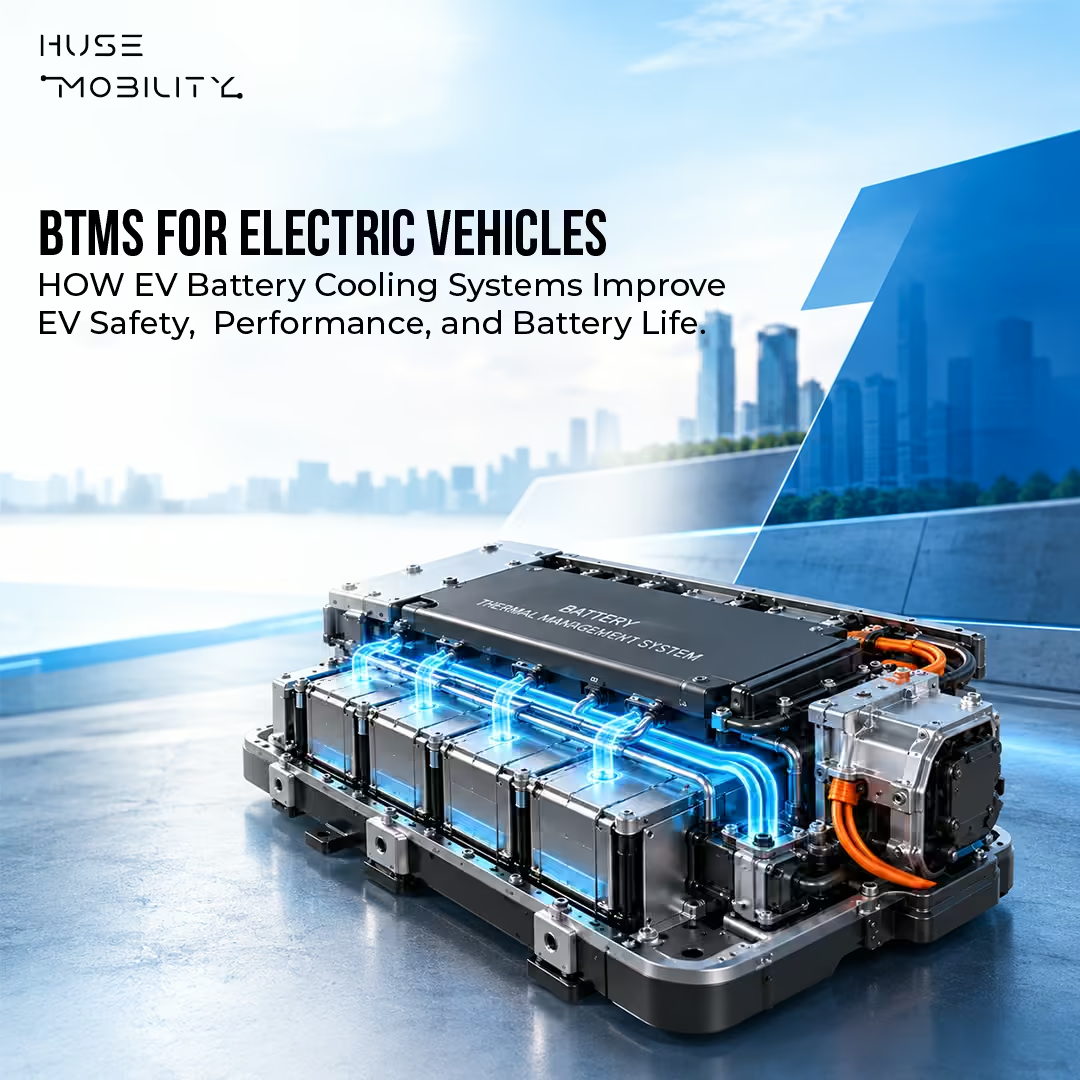
How EV Battery Cooling Systems Improve EV Safety, Performance, and Battery Life
Every EV owner eventually asks the same thing: why does battery health matter so much? The answer sits inside the pack, where heat quietly decides how far a car goes and how long its battery lasts.
A well-designed EV battery cooling system keeps cells within their ideal range, protecting range, charging speed, and safety together. Here’s how cooling technology actually works, and why it matters more than most drivers realize.
EV Battery Cooling System Demand in Upcoming Years
EV battery cooling system isn’t optional hardware tucked in a corner anymore. The global battery thermal management market is set to grow from 4.5 billion in 2026 to nearly 13.2 billion by 2035. It is climbing at over 12.7% a year, as per Global Market Insights. That kind of jump shows just how central battery temperature control has become to EV manufacturing worldwide.
BTMS for Electric Vehicles — The Main Cooling Types
BTMS for electric vehicles isn’t one piece of hardware; it’s a whole family of approaches suited to different battery sizes and budgets. Automakers pick a method based on how much heat the pack throws off, how fast it needs to charge, and how much weight or cost they can spare.
Some systems lean on simple airflow, others push coolant through channels bonded to the cells, and a growing number blend two techniques into one loop. Passive setups cost less and weigh less; active liquid or hybrid systems hold tighter temperature bands under hard use.
As batteries get denser and charging gets faster, the industry has leaned harder toward liquid and hybrid solutions. Here are the four main approaches used across today’s EVs:
- Air Cooling – Fan-driven airflow; light and cheap, but limited under fast charging or extreme heat.
- Liquid Cooling – Using coolant via plates/channels; the method used in all high-performance, high-range electric vehicle battery solutions.
- PCM Cooling – Phase-change materials absorb heat without active power usage, eliminating any sudden peaks in temperature.
- Hybrid Approaches – Combining liquid and PCM systems to strike a balance between cost, weight, and performance in fleets and locomotives.
Why Battery Temperature Control Is Important
Lithium-ion cells are sensitive. Run them too hot and the chemistry inside breaks down faster. This gradually degrades the battery capacity and, in worst cases, triggers thermal runaway.
Battery temperature control exists to keep cells inside a narrow, forgiving window, usually between 15°C and 35°C, whatever the weather or driving style throws at them. Get this wrong and the fallout shows up two ways: safety risk in the short term, and shortened electric vehicle battery life over the years.
EV battery safety and pack longevity are really two sides of the same thermal coin. That is why manufacturers invest so heavily in getting cooling right from day one instead of treating it as an afterthought.
Battery Temperature Control Methods Used in Modern EVs
Modern EVs rarely lean on one trick alone; they combine sensors, software, and hardware working together in real time. A battery management system constantly reads cell temperature and adjusts cooling response before things drift out of range.
- Real-time thermal sensors providing data for the BMS
- Active cooling cycles activated in case the temperature goes beyond a certain limit
- Cell balancing that ensures none of the cells overheat while the rest remain cool
- Insulated housing protecting the battery pack from external heat and moisture
The expert EV battery manufacturer in India integrates all four components into a single reliable package.
How Does a Strong Battery Thermal Management System Deliver Long-Lasting Performance?
The good design of a battery thermal management system prevents overheating and ensures that the battery can perform multiple cycles until its quality starts declining. Even the temperature of the cells decreases internal strain and inhibits chemical degradation of the battery while increasing its initial capacity over the years.
This is where the concept of long-lasting EV Batteries becomes reality. Apart from more durable batteries, their cooling system works on a daily basis as a background process.
- Lowers cell degradation caused by constant heat stress during rapid charging
- Maintains even temperature of all cells, preventing differential aging
- Facilitates increased cycles with proven cells up to 4,000 cycles
- Lessens warranty claims and need for early replacement of the packs
Read More –
Why Choose Huse Mobility for EV Battery Cooling System
Choosing the best cooling system isn’t all about specifications. It is more about the support available in case of any issues that may occur when the fleet starts running.
With Huse Mobility, you will have an EV battery cooling system designed with a Smart BMS, active protection layers, and phase-change cooling with the help of our technology partners. This makes us one of the top EV battery manufacturers in India, offering quality EV battery packs for two-wheelers and large energy storage needs.
FAQs on Battery Management System for Electric Vehicles
The EV battery cooling system ensures that the battery cells operate within the safe operating temperature during charging, driving, and even during the time that the vehicle is at rest.
What's the difference between air cooling, liquid cooling, and BTMS for electric vehicles using PCM?
Air cooling uses fans, which is lightweight but less accurate. Liquid cooling circulates coolant for tighter control, while PCM-based BTMS for electric vehicles absorbs heat passively. Many packs now combine two of these.
Yes. Heat is one of the fastest ways to age a lithium-ion cell, so keeping temperatures stable slows that degradation, which is exactly how a solid battery thermal management system delivers long-lasting batteries.
Local manufacturing means faster support and packs built for the Indian climate and roads from the start. Choosing an EV battery manufacturer in India like Huse Mobility means shorter lead times and thermal designs tuned to real local conditions.