
Vehicle Wireless Charging Station in India: Opportunities, Challenges, and the Way Forward
If you own an electric vehicle in India right now, your daily routine probably involves a bit of a wrestling match. You get home or reach the office, hunt for the charging cable (which is inevitably tangled or dusty), align the pins, and plug it in. It’s not the end of the world, but it’s not the “futuristic” experience we were promised.
Now, imagine a different scenario. You pull into your parking spot, or even better, you stop at a red light, and your car just… starts charging. No cables, no oily plugs, no getting out in the rain. This is the promise of a vehicle wireless charging station, and while it sounds like sci-fi, it’s closer to reality in India than you might think.
How Does It Actually Work? Understanding Vehicle Wireless Charging Station Technology
At its heart, wireless charging technology for cars isn’t that different from how you charge your smartphone. It uses something called “resonant magnetic induction.”
Think of it as two tuning forks. If you hit one, the other starts vibrating if it’s tuned to the same frequency. In an EV setup, you have a base pad on the ground (the transmitter) and a receiver pad under your car. When they align, energy jumps across the air gap via a magnetic field.
For those who want the technical bits: most modern systems, including those being explored by Huse Mobility, operate around the 85 kHz frequency. This is the “sweet spot” that allows power to transfer efficiently, even if your car isn’t parked perfectly to the millimetre.
The Big Opportunity: Why India Needs Wireless Technology and Vehicle Wireless Charging Station
India isn’t just any other market; it’s a chaotic, high-speed ecosystem of three-wheelers, delivery vans, and public buses that simply cannot afford to sit idle. For us, vehicle wireless charging technology isn’t a luxury, it’s a practical necessity to keep the wheels of commerce turning.
➤ Eliminating “Downtime” for Fleets:
For a delivery partner or a bus driver, every single second spent fumbling with a heavy cable is a second they aren’t earning money. By embedding this technology directly into loading docks or bus stops, the vehicle “snack charges” automatically the moment it pulls over. It’s hands-free and happens in the background, keeping the fleet moving without dedicated charging breaks.
➤ Space is a luxury:
Our Indian cities are incredibly tight and crowded. We don’t have the room for those massive, bulky wired charging pillars that eat up precious sidewalk space. Wireless charging systems are designed to sit level with the road, or even completely underground, so there are no bulky units or tangled wires sticking out. The result? Streets that look cleaner, feel less cluttered, and stay easy to walk through for everyone.
➤ Vandalism and Wear:
Let’s talk about what really happens on the ground. Open cables are an easy target for copper theft, and plastic connectors don’t stand a chance in crowded public areas, they get kicked, bent, cracked, or simply worn out over time.This technology solves this by being encased in solid concrete or heavy-duty industrial plastic. You can’t exactly “break” or steal a charging pad that’s hidden safely under the asphalt.
How Huse Mobility is Solving the Puzzle with Vehicle Wireless Charging Station Technology?
This is where local innovation matters. Huse Mobility isn’t just looking at static pads in a garage; they are looking at the “Electric Road.” We’re looking at Wireless Charging Solutions that happen while you drive.
Imagine a specific lane on the highway or a busy stretch in an industrial hub. As your truck or car drives over it, it’s picking up power. This is called “Dynamic Charging.” If we get this right, you won’t need those massive, heavy batteries that make EVs so expensive. You could have a smaller battery because the road itself is feeding you power.
The Way Forward: What happens next for Vehicle Wireless Charging Stations?
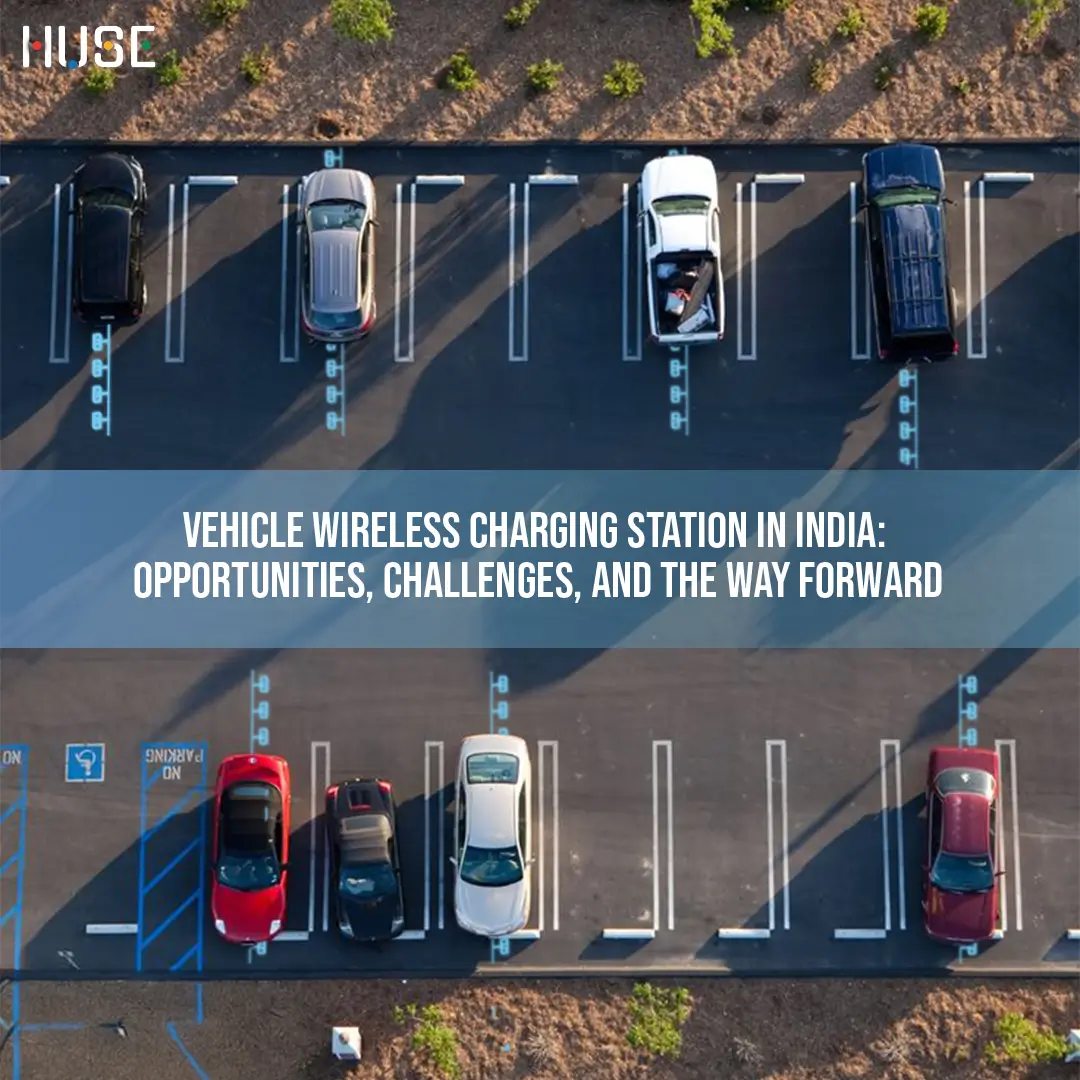
So, what’s the plan? We can’t wait for “someday.” The way forward is to start with “closed loops.” Think about big warehouses, airports, or tech parks. These are controlled areas where we can install vehicle wireless charging stations for fleets that run 24/7. We need to embrace the Wireless Charging Solutions that treat the city as a giant battery. As we move toward 2030, the goal is for the charging process to become invisible. You shouldn’t have to “go to a station”; the station should be wherever you happen to stop.
Conclusion
Wireless charging isn’t just a “lazy person’s luxury.” It’s a structural necessity for a country that wants to lead the EV revolution. When we remove the cable, we remove the friction. We make EVs as easy to use as a traditional petrol car, maybe even easier.
At Huse Mobility, the focus is on building that “invisible” backbone. Whether it’s a pad in your driveway or a coil under the highway, the transition to wireless is the next logical step in our journey toward a cleaner, smarter India.
Are you a fleet owner or a property developer looking to future-proof your parking? Wireless is no longer a “someday” technology; it’s being deployed right now. Reach out to Huse Mobility to see how we can help you cut the cord and move into the future of electric mobility.